The product
Four engines, one reconciled call, and the argument behind it.
AI extracts structure from language. Deterministic math produces every number. That split is why a score can be re-derived tomorrow and come out the same — and why we can show you the arithmetic instead of asking for trust.

News Impact
10 min market hours · 15 min off-hours
Reads every article that crosses our news feeds for a ticker, ranks them, and feeds the top 50 into the aggregate score.

Technical Analysis
daily, after 4:00 PM ET
Fully quantitative, zero AI. Price structure computed rather than interpreted, then adjusted for the prevailing market regime.

Crowd Focus
every 3 hours
Attention and sentiment on X, measured rather than modeled. It answers one question: is this move already crowded?

Fusion
several times per trading day
Reconciles all three under one fixed rule set and writes the argument in plain English.
The output
Every read carries the same six things.
Not a score in isolation. A short written assessment you can argue with — which is also what makes it checkable a week later.
01
Direction
Five core states from Strong Bullish to Strong Bearish, plus explicit at-risk flags. Never a price target, never a recommendation.
02
The setup, named
Trend continuation, Trend reversal risk, Momentum extended, Awaiting setup. The engine names the structure it thinks the stock is in — not just which way it leans.
03
Evidence support
How much data actually stands behind the call — layer availability, freshness, cross-layer alignment. Not a probability.
04
Each engine's own score
News, Technical and Crowd shown separately, so you can see where the call came from — and where it didn't.
05
Written synthesis
Plain English on how the conflict was resolved and which layer led. This is the part no chart gives you.
06
Risk note & levels
What would break this read, and the specific prices at which it breaks. Stated before the fact, not after.
Inside the app
Four screens. That's the whole surface.
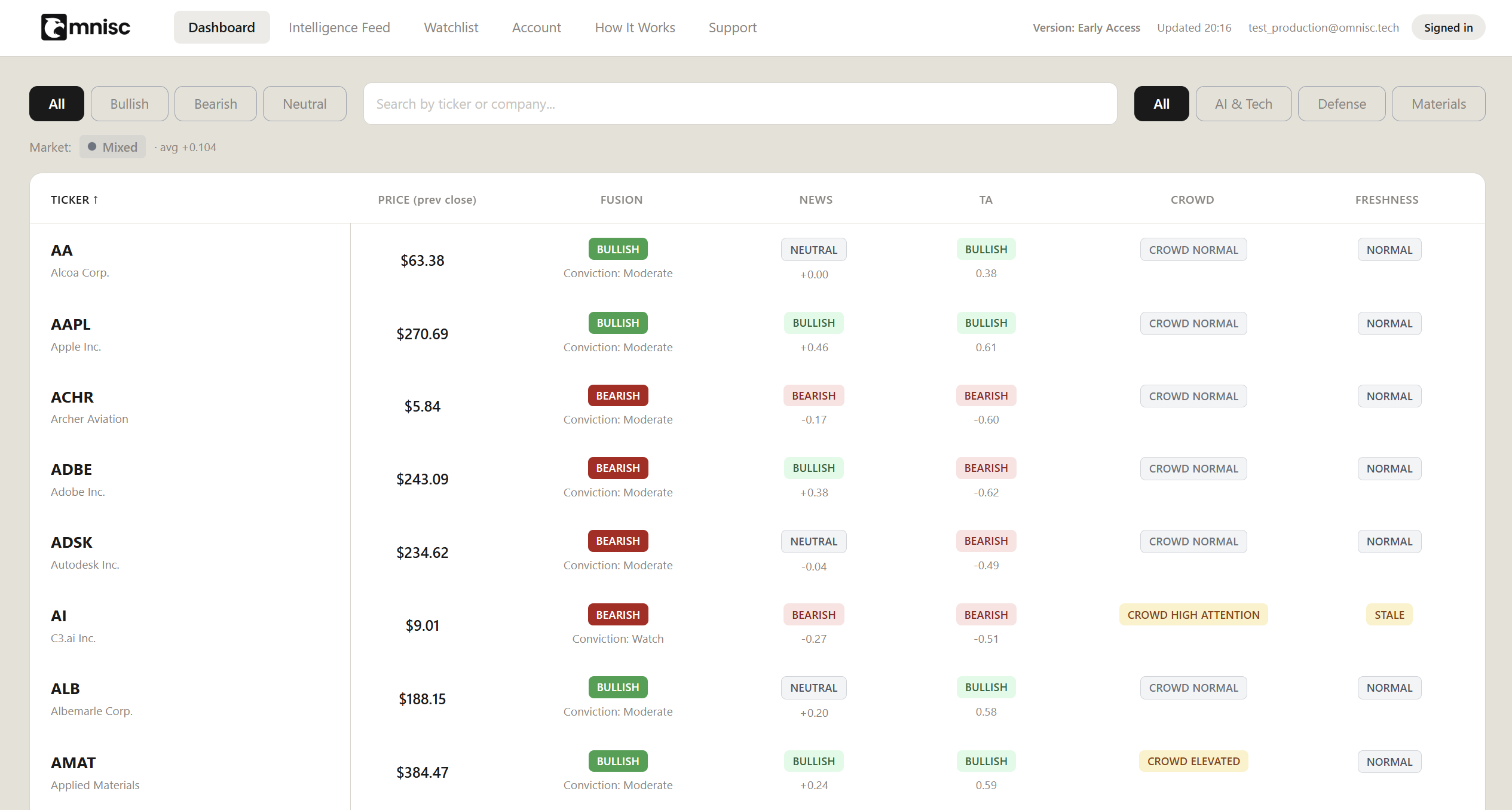
01 · Dashboard
All 150+ tickers, one row each
Every row carries the Fusion call, its risk level, the named setup behind it and the three engine sub-scores — with the market's temperature and average score sitting above them. Sort by the Fusion column and the names where the engines disagree surface first; that is the whole morning routine.
Filter by sector, direction or freshness. Watchlist pins the names you hold.
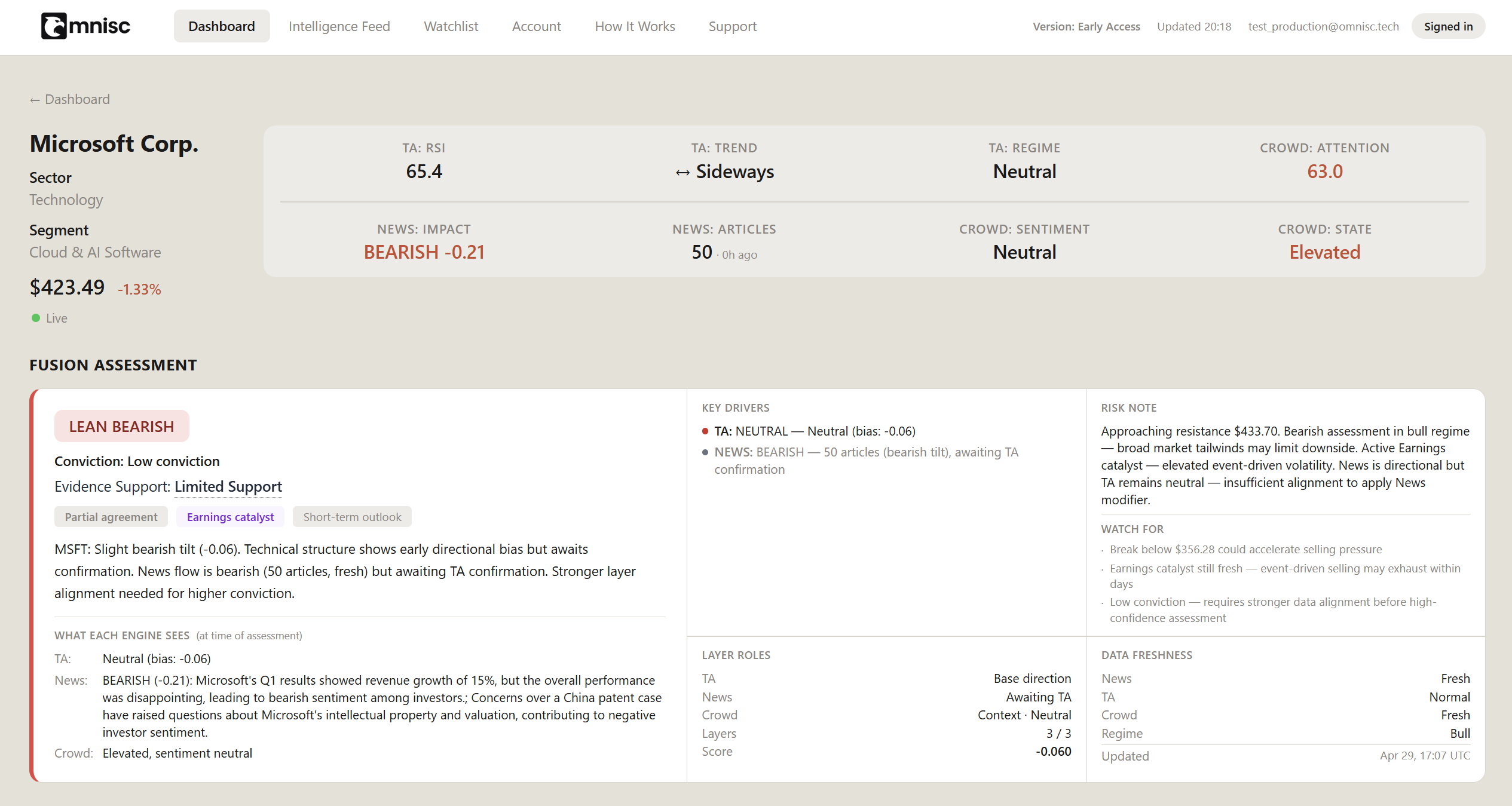
02 · Ticker detail
The full read, layer by layer
Each engine's own score with its reasoning, then the Fusion synthesis that reconciles them: which layer led, why the others didn't, what would break the call, and the specific level at which it breaks.
Expand any engine to see the inputs it used and when they last refreshed.
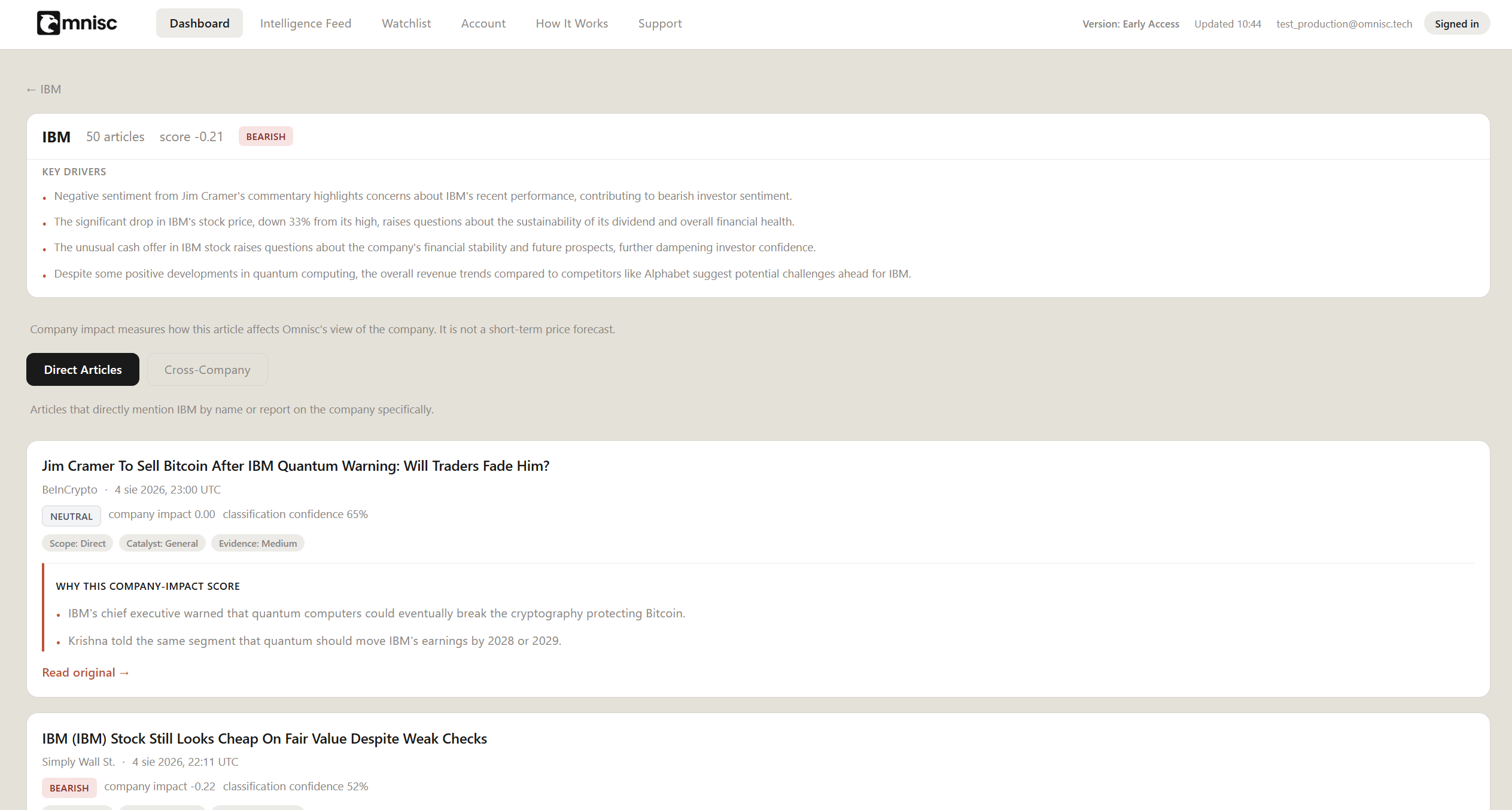
03 · News
The news ledger, per ticker
All news for one company in one place — every article that crossed the feeds for the ticker, not just the ones that made the score.
Cross-ticker influence is explicit: when another company's news moves this name — a supplier's print, a customer's guidance — the spillover is shown and attributed rather than silently blended in.
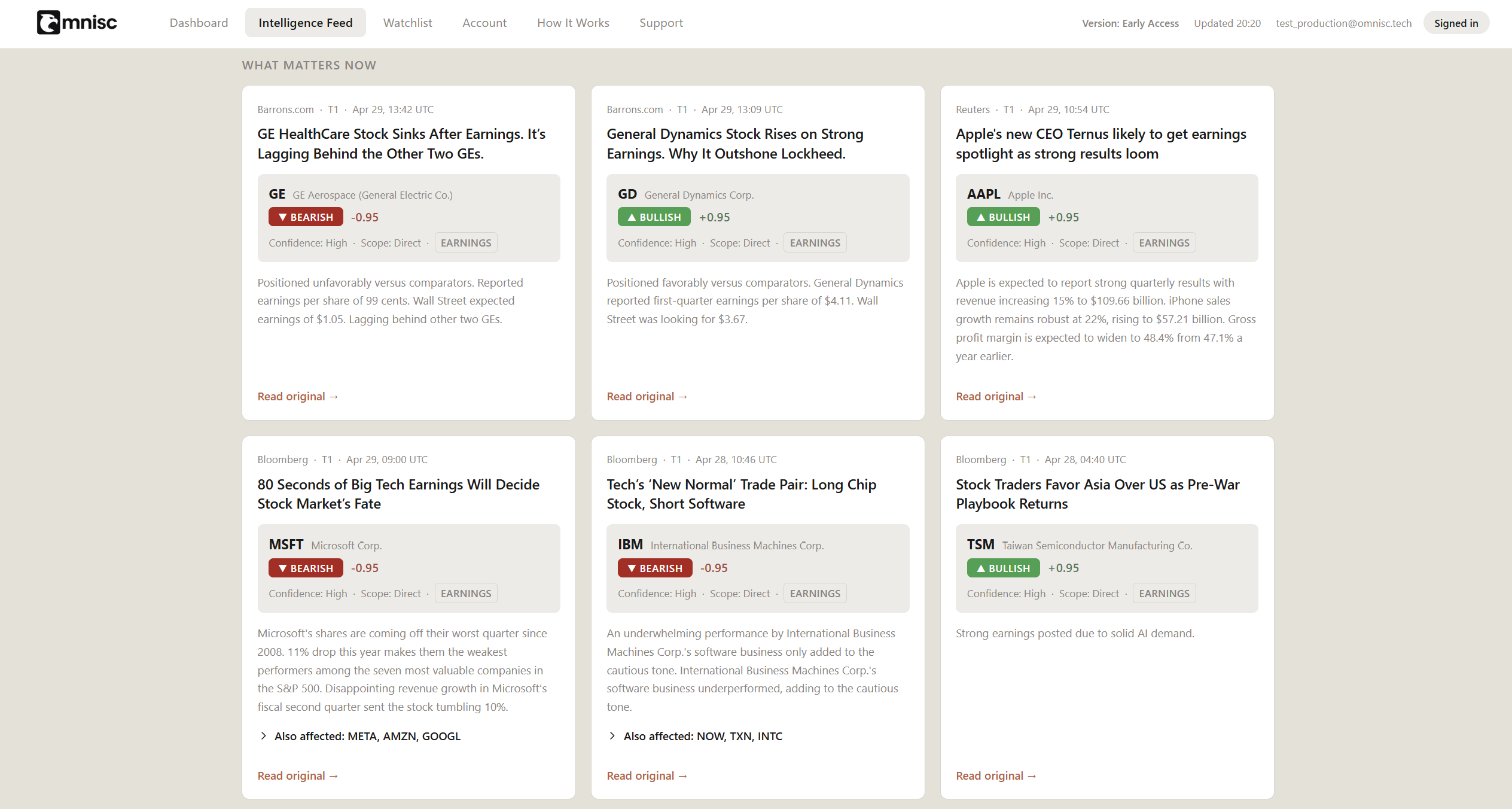
04 · Intelligence Feed
News with a score attached, not a headline wall
Every article that entered a ticker's top 50 appears here with its impact score, catalyst type and which tickers it touched — including the ones it reached through sector spillover.
Filter to one ticker to see exactly what the News engine read today, and what it discarded.
Coverage
150+ tickers, chosen because news actually moves them.
A curated universe beats a crawled one. These are names where headlines, contracts and supply shocks produce measurable price response — which is the only condition under which a news engine earns its place.
Coverage expands toward 200+ in 2027. Requests from subscribers are weighted first.
AI & Technology
Semis, hyperscalers, data-centre supply chain, enterprise software.
NVDA · AMD · ASML · PLTR · AAPL
Defense
Primes and suppliers where contract awards and budget cycles move price.
RTX · LMT · GD · NOC · LHX
Materials
Copper, gold, lithium and rare earths — supply headlines with direct read-through.
FCX · NEM · MP · ALB · SCCO
Spillover routing
A sector affinity matrix means a TSMC article also scores NVDA. Coverage is wider than the ticker list suggests.
On accuracy — the honest version
Every assessment Omnisc has produced is logged, timestamped, versioned against the engine build that made it, and tracked through forward windows against what the market actually did.
We are not publishing a hit-rate number yet. The Technical engine is mid-recalibration, and a figure measured against a build we're replacing would be marketing, not evidence. When calibration closes, the number appears here with its sample size and forward window next to it.
Refresh schedule you can check
Every card carries a freshness badge, so you always know which of these last ran.
Read the engines on your own tickers for a week.
No charge during the trial · cancel in one click · informational only, not financial advice